

 12 min read
Facebook ads for ecommerce still work, but the margin for sloppy setup is much thinner than it was a few years ago. The stores that win now usually have three things working together: clean conversion data, product pages that can turn ad clicks into orders, and an ad account setup that does not collapse the minute spend increases.
This guide focuses on that operating layer. Meta positions ecommerce advertising around AI-powered campaign tools, shopping experiences, and performance best practices, but the tools you connect around Meta often decide whether the system has enough signal to optimize. We evaluated three requested tools - wetracked.io, Kopy, and AdRevival - as practical support pieces for ecommerce Meta ads.
Quick verdict: use wetracked.io when attribution and server-side event quality are your bottleneck, Kopy when product-page creation and testing speed are slowing you down, and AdRevival only when you already spend enough that agency ad account infrastructure, replacements, and support are worth the retainer. A $50-a-day store probably needs better data and better pages before it needs more account machinery.
Facebook Ads for Ecommerce: The Setup Framework
Before picking software, separate the work into layers. This keeps the buying decision grounded in the actual leak you are trying to fix.
- Tracking layer: Pixel, Conversions API, server-side events, event matching, and clean purchase values. If this layer is weak, Meta optimizes against fuzzy signals.
- Offer and page layer: Product-page speed, benefit clarity, creative-message match, social proof, price anchoring, and checkout friction.
- Account layer: Campaign structure, account health, billing, permissions, backups, compliance, and the operational ability to keep campaigns live.
- Creative layer: Angles, hooks, product demos, UGC-style assets, catalog ads, and test cadence.
- Scaling layer: Budget increases, inventory readiness, contribution margin, cash conversion cycle, and fulfillment capacity.
Most ecommerce teams try to buy the scaling layer first because it feels exciting. In practice, the boring layers pay for the exciting layer. Fix event quality, product-page quality, and account resilience before judging whether Meta is the problem.
Tool Comparison for Ecommerce Meta Ads
Use this as a buying shortcut, then read the tool-specific notes before committing budget.
| Tool | Best role in the stack | Use when | Not ideal when | Pricing checked May 20, 2026 |
|---|---|---|---|---|
| wetracked.io | First-party ad tracking and event enrichment | Your Shopify or WooCommerce store has attribution gaps, weak event matching, or ad blockers/iOS privacy noise hurting optimization. | You have very low spend, no repeatable offer yet, or only need basic Pixel setup. | Public pricing showed plans from $49/month, with higher tiers based on order volume and stores. |
| Kopy | Fast Shopify product-page import and AI page generation | You test many products or need faster product-page creation from suppliers, competitors, marketplaces, or existing stores. | You already have a mature product-page workflow, custom CRO design system, and strict brand QA. | Homepage pricing section showed plans from $4.99/month, with AI and protection features on higher tiers. |
| AdRevival | Meta agency ad account infrastructure | You are scaling spend and need agency account access, replacements, account setup, support, and fixed spend-fee economics. | You are early, unproven, compliance-risky, or hoping infrastructure will fix poor offers. | Meta account page showed retainers from $299/month to $2,499/month depending on monthly spend limits and support level. |
Pricing is volatile. Treat these as captured public page observations, not a guarantee; check each official page before purchase.
How We Evaluated the Tools
We ran a live U.S. English SERP check for facebook ads for ecommerce with DataForSEO, then reviewed the top article-style results and official product pages. The ranking pages leaned heavily into tactics: Conversions API, campaign structure, ad formats, retargeting, audience targeting, creative, and scaling. Useful, but they mostly treat the ecommerce stack around Meta as a side note.
The ToolBlueprints gap is practical: which support tools help a store act on those tactics? For that, we looked at each product by role, verified current public positioning and pricing pages, captured screenshots, and wrote the recommendation around failure modes rather than feature volume.
Disclosure: ToolBlueprints may earn commissions from some links, but recommendations are based on fit, tradeoffs, and verified product information. Read our methodology and affiliate disclosure for context. If you are building on Shopify, the related Shopify review is also useful background.
Selection Rule
If you cannot name the bottleneck, do not buy the tool yet. Pick one: bad tracking, slow product-page production, unstable account infrastructure, weak creative, or poor offer economics. Then choose software that fixes that bottleneck without creating a second job for the team.
1. wetracked.io: Best When Meta Needs Cleaner Conversion Data
wetracked.io positions itself as ad tracking software for Shopify and WooCommerce, with first-party tracking, enrichment, and real-time forwarding of conversion data into ad channels. Its public pages focus on recovering signal affected by cookies, ad blockers, iOS privacy changes, and incomplete store-side capture.
That matters because Meta campaigns are only as good as the events they learn from. If purchases are missing, values are wrong, or attribution is split between dashboards, you can make bad budget decisions even when the campaign interface looks confident. This is where a tracking tool can earn its place.
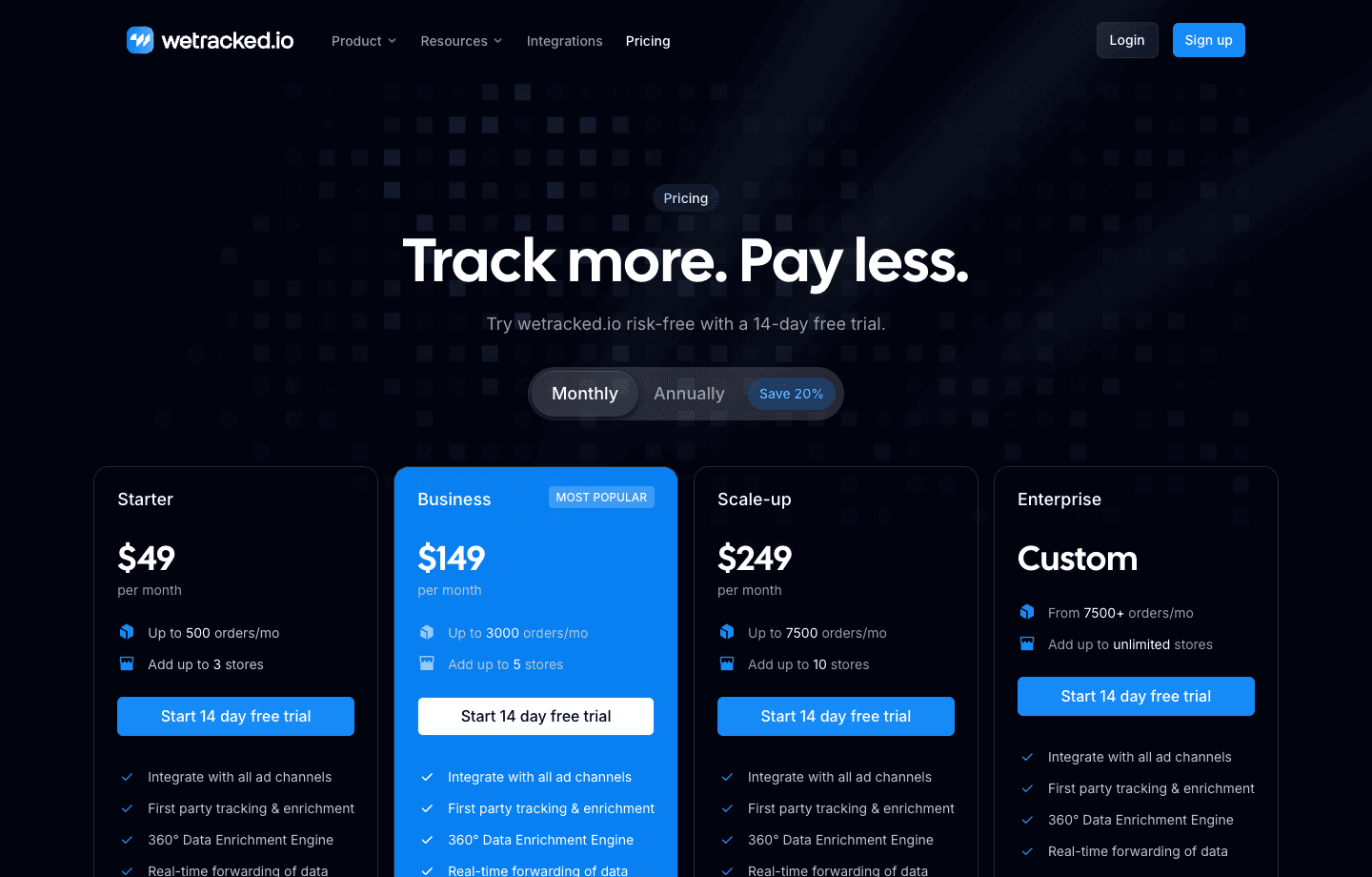
On May 20, 2026, the public pricing page listed a 14-day free trial and plans starting at $49/month for Starter, $149/month for Business, and $249/month for Scale-up, with order-volume and store-count limits. The page also listed support for Shopify, WooCommerce, several checkout plugins, and ad channel integrations including Meta, TikTok, Google Ads, Pinterest, Snapchat, and X.
Best fit: stores that already have traffic and revenue, but do not trust the numbers enough to scale. Less ideal: tiny stores still validating product-market fit, because better event tracking cannot rescue an offer people do not want. Pricing and platform support checked on May 20, 2026: wetracked.io official pricing.
2. Kopy: Best When Product-Page Speed Is the Bottleneck
Kopy is a Shopify-focused product-page tool. Its homepage says it can import products and build Shopify product pages in one click with AI, native translation, AI copywriting, and support for importing from platforms such as Shopify, AliExpress, CJ Dropshipping, Etsy, Amazon, Shein, Alibaba, and Temu.
For ecommerce Facebook ads, that is not just a convenience feature. Creative tests are often wasted when every click lands on a weak product page. If your team can produce new angles, bundles, and product pages faster, you can test offers with less manual drag. The risk is obvious: speed without QA can create thin, duplicated, or off-brand pages.
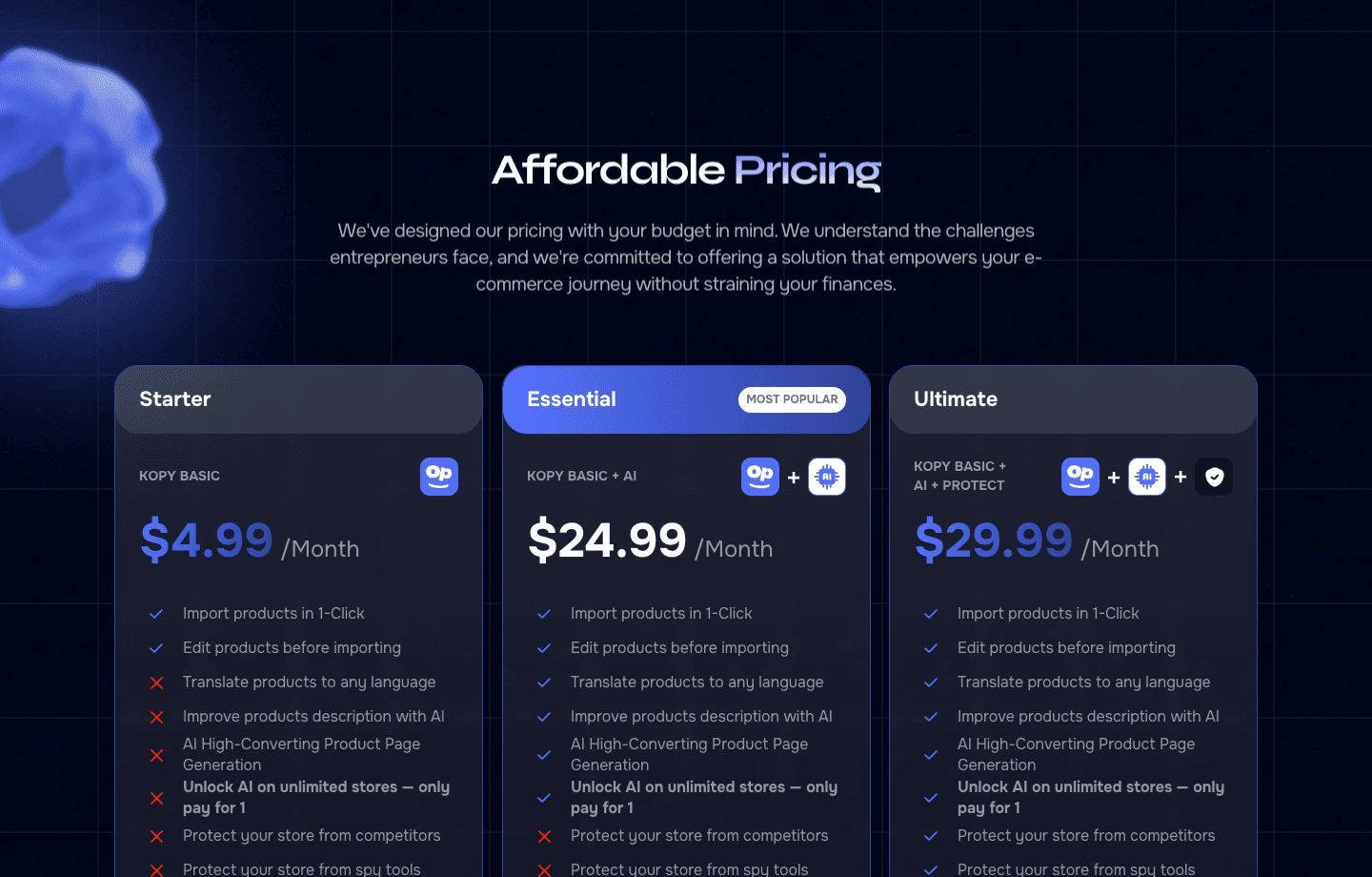
On May 20, 2026, Kopy displayed Starter at $4.99/month, Essential at $24.99/month, and Ultimate at $29.99/month. The higher tiers added AI page generation and protection features. Those prices make it low-friction to test, but the real cost is editorial control: someone still has to check claims, product details, page structure, translations, and compliance before sending paid traffic.
Best fit: dropshippers, Shopify operators, and small ecommerce teams that test many product pages and want faster creation. Less ideal: established brands where landing-page quality, legal review, and brand voice matter more than raw production speed. Product positioning and pricing section checked on May 20, 2026: Kopy official homepage and pricing section.
3. AdRevival: Best for Account Infrastructure at Higher Spend
AdRevival sells Meta agency ad account access and related infrastructure. Its Meta page highlights zero spend fees, cashback or points on some plans, agency ad accounts, replacements, Facebook setup, and 24/7 support. Its broader site also positions the company around TikTok and Meta agency ad accounts.
This belongs in a different buying category from tracking or product-page software. AdRevival is not there to improve your product offer or write better ads. It is an infrastructure play for media buyers who need account continuity, support, and predictable fee structure while spending at a level where downtime is expensive.
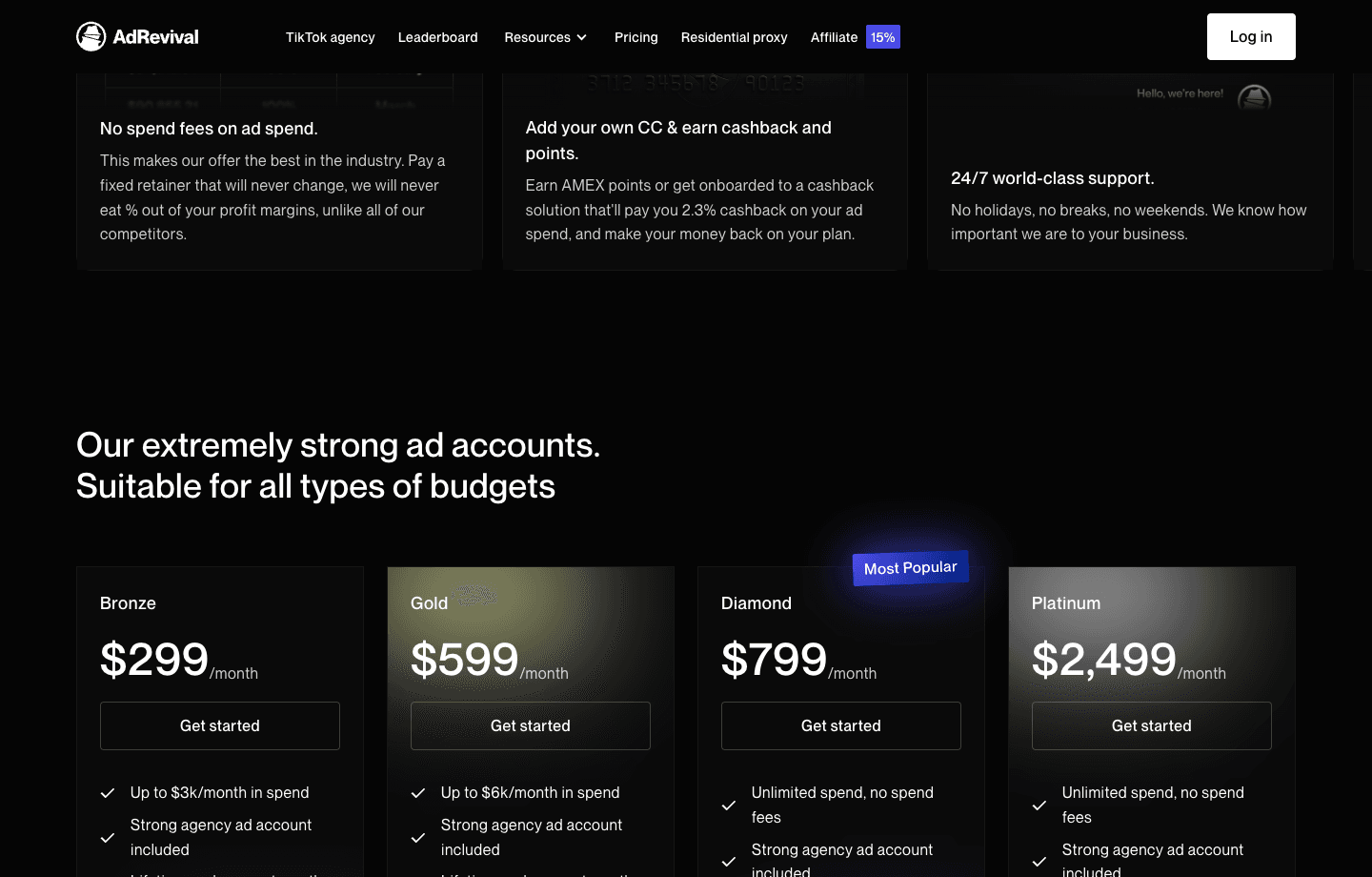
On May 20, 2026, the Meta-specific pricing page showed Bronze at $299/month with up to $3k/month in spend, Gold at $599/month with up to $6k/month in spend, Diamond at $799/month with unlimited spend and no spend fees, and Platinum at $2,499/month. The page also says clients must comply with Meta terms and lists restricted verticals in its FAQ.
Best fit: experienced ecommerce media buyers with validated offers, real spend, and a need for account redundancy. Less ideal: new stores, gray-area advertisers, or teams expecting agency accounts to overcome poor compliance, poor creative, or weak economics. More plumbing will not make a leaky offer profitable. Meta agency account positioning and pricing checked on May 20, 2026: AdRevival Meta agency account page.
Which Tool Should You Start With?
Choose by store stage, not by the longest feature list.
- New store or early product testing: Start with product-page quality and offer validation. Kopy may help if page creation is slow, but do not automate your way into generic pages.
- Growing store with inconsistent attribution: Prioritize tracking. wetracked.io makes the most sense once you have enough traffic and order volume for better signal to change decisions.
- Scaling store with account-risk exposure: Evaluate AdRevival only after you know your offer, margins, compliance posture, and daily spend justify agency account infrastructure.
- Shopify operator running Meta and TikTok: You may eventually use all three, but sequence matters: page testing, event quality, then account resilience.
A sensible stack for many ecommerce teams is: Shopify plus a clean product-page workflow, Meta Pixel and Conversions API basics, a tracking layer when attribution becomes material, and account infrastructure only after spend makes downtime expensive.
90-Day Implementation Plan
A practical sequence for stores trying to improve Meta performance without buying everything on day one.
| Phase | What to do | Tool relevance | Success signal |
|---|---|---|---|
| Days 1-14 | Audit Pixel, Conversions API, purchase values, UTM hygiene, product-page speed, checkout friction, and Meta account health. | No new tool required yet unless a severe gap is obvious. | You can name the top two leaks with evidence. |
| Days 15-30 | Fix product pages and creative-message match for the top products. Build two or three clean page variants before scaling budget. | Kopy can speed up Shopify product-page creation and translation workflows. | Ad click to product-page engagement improves, and QA finds fewer page issues. |
| Days 31-60 | Clean event quality and attribution. Compare store revenue, Meta-reported revenue, and server-side event coverage. | wetracked.io becomes relevant if signal loss affects budget decisions. | Purchase events and revenue attribution become more trustworthy. |
| Days 61-90 | Scale only campaigns with stable contribution margin, enough inventory, clean events, and account contingency planning. | AdRevival becomes relevant when account continuity is financially meaningful. | Budget increases do not create operational panic or reporting fog. |
Keep the first rollout simple enough that someone will actually maintain it every week.
Common Mistakes to Avoid
- Buying tracking before traffic: A better attribution layer cannot create signal from tiny sample sizes.
- Scaling weak pages: If the product page does not answer objections, paid traffic just discovers that faster.
- Confusing account access with compliance: Agency account infrastructure does not remove your obligation to follow platform rules.
- Treating Meta as the only dashboard: Use store revenue, MER, contribution margin, and cash flow alongside platform ROAS.
- Adding tools without owners: Every tool needs a weekly owner for QA, setup, and decision-making.
Final Recommendation
For most ecommerce operators, the right order is: make product pages testable, make conversion data trustworthy, then harden account infrastructure. Kopy is the lightest first experiment if page creation is slow. wetracked.io is the stronger bet once attribution quality affects spend decisions. AdRevival is a later-stage infrastructure choice for teams where ad account downtime is expensive enough to justify a fixed retainer.
If you only take one idea from this guide, make it this: Meta ads reward operational clarity. The platform can find buyers faster when your store sends clean events, the landing page matches the ad promise, and the account setup stays stable while budget moves.
FAQ
What is the best tool for Facebook ads for ecommerce?
There is no single best tool for every store. Kopy is most useful for faster Shopify product-page testing, wetracked.io is most useful for cleaner conversion tracking, and AdRevival is most useful for higher-spend advertisers who need Meta agency account infrastructure.
Do ecommerce stores still need Meta Conversions API?
Yes. Meta still describes the Conversions API as a way to send marketing data from servers, websites, apps, or CRM systems to Meta. Many ecommerce stores use it alongside the Pixel. Tracking tools can extend or enrich that setup, but they do not remove the need to understand what events you are sending.
Should I use Kopy for every product page?
Use Kopy where speed helps you test product-page ideas, imports, and translations. Do not skip QA. Product descriptions, claims, images, guarantees, pricing, and compliance still need human review before you send paid traffic.
When is wetracked.io worth it?
wetracked.io is more likely to be worth it when your store already has enough traffic and orders that better conversion data can influence budget allocation. If you are still making your first few sales, fix the offer and page first.
When should an ecommerce brand consider AdRevival?
Consider AdRevival when you are spending enough that account downtime, replacements, support, and fee structure have real financial impact. It is not a substitute for compliant ads, strong creative, or profitable unit economics.
How much should ecommerce brands spend before adding paid tools?
Start with free platform basics and store analytics. Add paid tools when the tool fixes a measured constraint: slow launch velocity, unreliable attribution, or account risk. If the constraint is vague, the purchase will be vague too.