
 12 min read
If you are choosing between WeTracked and TrackBee, the short version is simple: WeTracked is the more flexible ecommerce tracking tool because it supports Shopify, WooCommerce, and several custom checkout stacks at a lower published entry price. TrackBee is the sharper Shopify-only pick when you want a guided server-side tracking layer with Klaviyo recovery and revenue-based pricing that scales with tracked sales.
Both products try to solve the same painful ecommerce problem: ad platforms under-report purchases, attribution gets thinner after privacy changes, and teams lose signal quality when checkout events are blocked or duplicated. The difference is where each product draws its boundaries. WeTracked positions itself as a broad conversion API and ad tracking layer across ecommerce platforms. TrackBee focuses on Shopify merchants and pushes a cleaner capture, enrich, distribute workflow for server-side tracking.
This comparison uses official pricing, integration, setup, and privacy pages checked on May 20, 2026, plus review-directory SERP benchmarks from Software Advice and Capterra. For the individual ToolBlueprints profiles, see WeTracked and TrackBee.
Editorial disclosure
ToolBlueprints compares software using public product documentation, live pricing pages, first-party feature claims, and visible SERP/review signals. This article is not sponsored by WeTracked or TrackBee.
Quick Verdict
Choose WeTracked if your store stack is more complex than Shopify, if you need WooCommerce or custom checkout coverage, or if you want predictable plan limits based on monthly orders instead of tracked revenue. Its published plans start at $49 per month and include unlimited ad spend, revenue, and pixels, which makes it easier to estimate cost for early stores.
Choose TrackBee if your business runs on Shopify and the main goal is a low-maintenance tracking layer for Meta, Google, TikTok, Pinterest, Microsoft Ads, GA4, and Klaviyo. Its published plans start at €79 per month and are tied to tracked revenue, so it can fit stores that want pricing to scale with commercial volume rather than order count.
Choose WeTracked When
- You run Shopify plus WooCommerce, Funnelish, CheckoutChamp, Sticky.io Checkout, or another checkout stack.
- You want lower published entry pricing and clear monthly order bands.
- You need direct support for several paid social pixels and custom ecommerce implementations.
- You prefer unlimited ad spend, revenue, and pixels on published plans.
Choose TrackBee When
- Your store is Shopify-first and you want a tracking system built around that assumption.
- Klaviyo recovery and server-side event quality are important parts of the business case.
- You want no-code setup, deduplication, consent-aware tracking, and ongoing maintenance handled by the platform.
- You are comfortable with revenue-based thresholds and overage fees.
WeTracked vs TrackBee at a Glance
A practical summary for ecommerce operators comparing tracking accuracy, platform fit, pricing model, and migration risk.
| Category | WeTracked | TrackBee | Winner |
|---|---|---|---|
| Best overall fit | Multi-platform ecommerce brands that want conversion API coverage across several checkout setups. | Shopify merchants that want focused server-side tracking and Klaviyo recovery. | Depends on stack |
| Entry pricing | $49/month Starter plan for up to 500 orders/month. | €79/month Start plan with €25K tracked revenue included. | WeTracked |
| Pricing risk at scale | Order-based tiers can be easier to forecast if order volume is stable. | Revenue-based tiers and extra tracked-revenue fees can rise with average order value. | WeTracked for predictability |
| Platform coverage | Shopify, WooCommerce, Funnelish, Checkify, CheckoutChamp, BetterCart, UnifyCheckout, Sticky.io Checkout, and custom third-party support. | Shopify-centered setup with integrations for ads, analytics, Klaviyo, Calendly, and Funnelish. | WeTracked |
| Klaviyo recovery | Klaviyo appears in its integration ecosystem, but recovery is not the core homepage pitch. | Klaviyo is an explicit integration and part of its broader server-side recovery story. | TrackBee |
| Setup and maintenance | Guided setup with ecommerce-platform documentation and third-party checkout support. | No-code Shopify setup, automatic event deduplication, enrichment, and no ongoing maintenance positioning. | TrackBee for Shopify |
| Privacy and governance | Publishes privacy policy and conversion API infrastructure details; teams still need to map consent requirements. | Emphasizes GDPR-aware tracking and respecting Shopify consent settings. | TrackBee for Shopify consent flow |
Pricing and feature claims were checked on May 20, 2026 from the official vendor pages linked in this article.
How We Compared Them
The scoring below gives the most weight to platform fit, integration coverage, pricing clarity, implementation effort, signal quality, and switching risk. Official vendor pages were prioritized over third-party summaries because tracking products change pricing and integrations frequently.
For WeTracked, the key sources were its homepage, pricing page, integration directory, Shopify onboarding documentation, and privacy policy. For TrackBee, the key sources were its homepage, pricing page, integration directory, how-it-works page, and privacy policy.
The SERP itself is thin. Software Advice and Capterra have review-directory comparison pages for TrackBee vs WeTracked, but the ranking set lacks a detailed ecommerce operator guide. That is the gap this article fills: not just which profile has more checklist features, but which product is less risky for a real store stack.
Pricing and Total Cost of Ownership
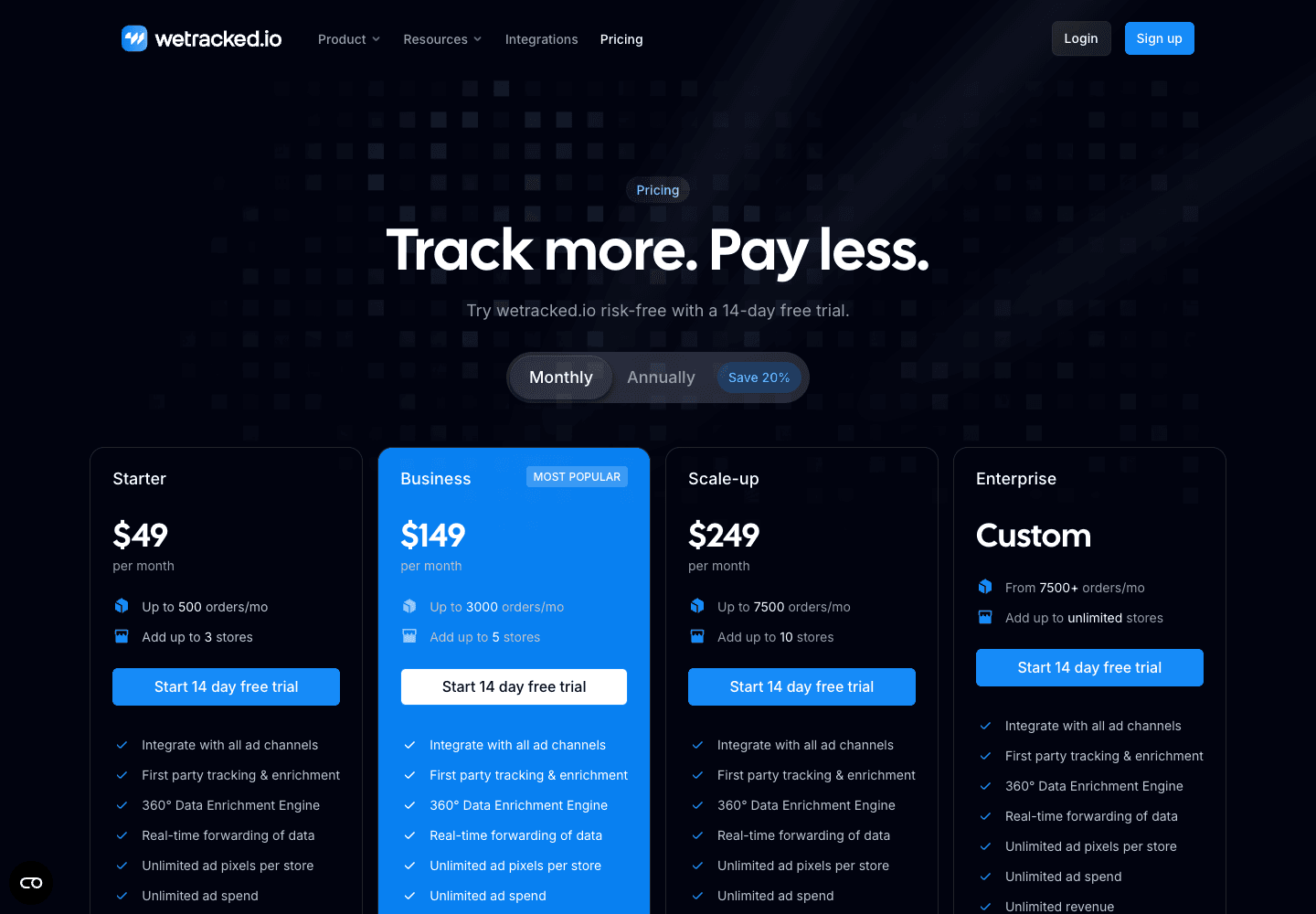
WeTracked publishes four tiers. Starter is $49 per month for up to 500 orders and up to three stores. Business is $149 per month for up to 3,000 orders and up to five stores. Scale-up is $249 per month for up to 7,500 orders and up to ten stores. Enterprise is custom for stores above 7,500 orders and includes unlimited stores. Annual billing is advertised with a 20% discount, and the public page lists a 14-day free trial.
TrackBee prices by tracked revenue. Start is €79 per month excluding VAT with €25K tracked revenue, up to two stores, and €6 for each extra €1K in tracked revenue. Pro is €199 per month with €100K tracked revenue, up to four stores, and €1 for each extra €1K. Scale is €449 per month with €500K tracked revenue, up to six stores, and €0.75 for each extra €1K. Advanced is custom for businesses above €2M tracked revenue and unlimited stores. TrackBee lists a 30-day free trial.
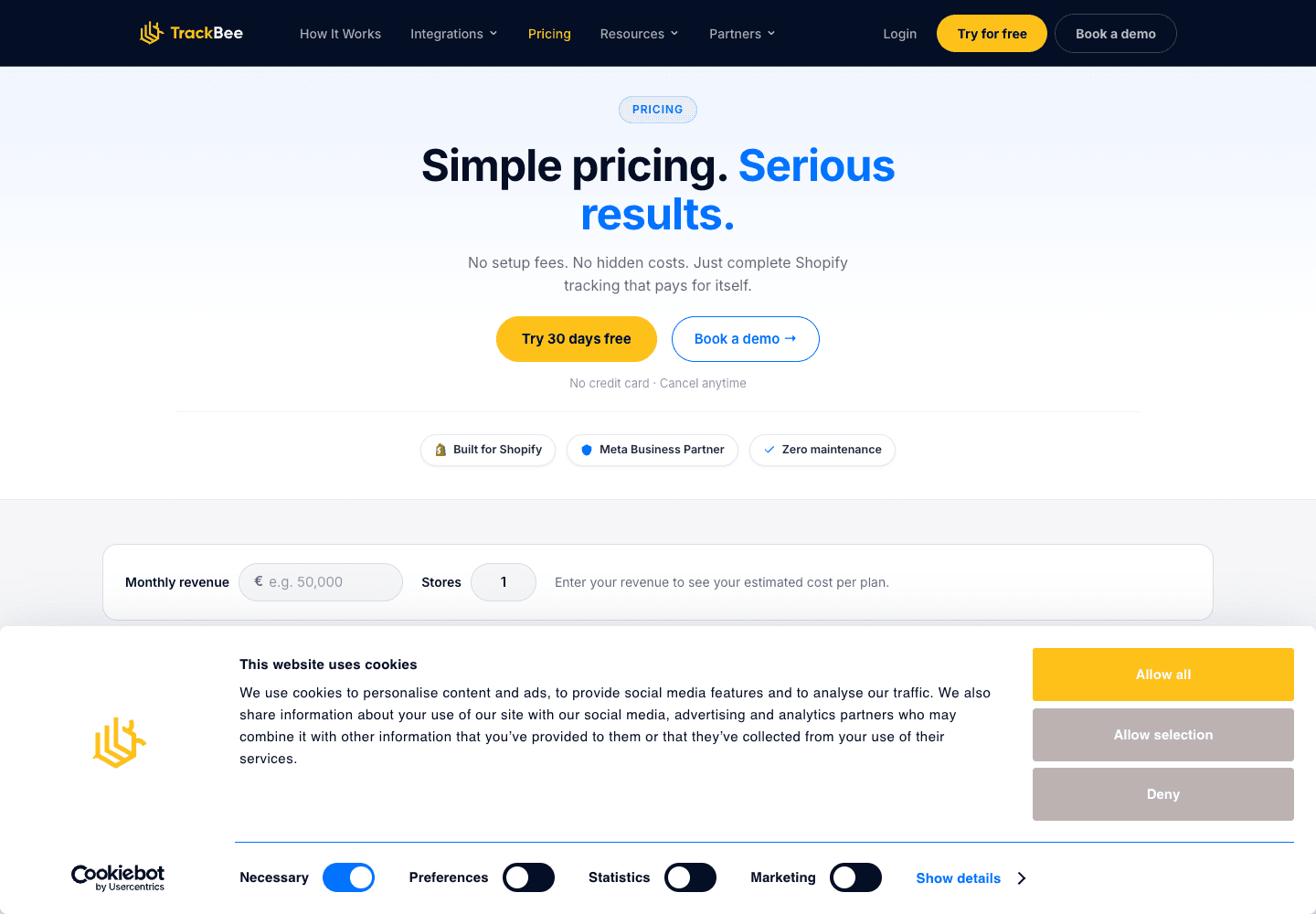
The pricing model matters more than the headline plan. A low-order, high-average-order-value Shopify store may hit TrackBee revenue thresholds sooner than WeTracked order thresholds. A high-order, low-AOV store may feel the opposite. If finance needs clean forecasting, WeTracked is easier to model because the public tiers are tied to order volume. If the business wants software cost to scale with revenue captured, TrackBee’s model is more aligned.
Pricing Comparison
Published monthly pricing checked on May 20, 2026. VAT, overage, annual discounts, and custom enterprise terms can change the final invoice.
| Tier | WeTracked | TrackBee | What to watch |
|---|---|---|---|
| Entry plan | $49/month for up to 500 orders and up to 3 stores. | €79/month excl. VAT with €25K tracked revenue and up to 2 stores. | TrackBee can cost more if tracked revenue rises quickly. |
| Mid-market plan | $149/month for up to 3,000 orders and up to 5 stores. | €199/month excl. VAT with €100K tracked revenue and up to 4 stores. | Compare order volume against revenue cap before choosing. |
| Scaling plan | $249/month for up to 7,500 orders and up to 10 stores. | €449/month excl. VAT with €500K tracked revenue and up to 6 stores. | TrackBee adds lower overage rates on larger plans. |
| Enterprise | Custom for 7,500+ orders and unlimited stores. | Custom Advanced plan for €2M+ tracked revenue and unlimited stores. | Ask both vendors for event volume, support SLA, and onboarding details. |
| Trial | 14-day free trial listed on pricing page. | 30-day free trial listed on pricing page. | TrackBee gives more time to validate tracking lift before paying. |
Feature-by-Feature Comparison
Platform Fit
WeTracked has the broader commerce footprint. Its integration page lists Shopify, WooCommerce, Funnelish, Checkify, CheckoutChamp, BetterCart, UnifyCheckout, Sticky.io Checkout, and custom third-party support. That matters for ecommerce teams with international funnels, subscription checkout experiments, post-purchase flows, or legacy WooCommerce stores.
TrackBee is more opinionated. The product messaging is Shopify-first, and that focus is a strength if your team wants fewer implementation branches. Its how-it-works page explains a workflow built around capturing events from Shopify, enriching sessions, deduplicating events, and distributing cleaner data to ad and marketing destinations.
Event Capture and Signal Quality
Both tools exist because browser-only tracking is fragile. WeTracked emphasizes server-side ad tracking, conversion API connections, unlimited pixels, and improved purchase attribution. TrackBee emphasizes enriched server-side events, deduplication, and consent-aware distribution. For a Shopify store, TrackBee explains the event journey more clearly. For a mixed checkout environment, WeTracked gives more implementation paths.
Integrations
WeTracked covers Meta, TikTok, X, Pinterest, SnapChat, Google Ads, Klaviyo, Shopify, WooCommerce, and multiple checkout tools. TrackBee lists Shopify, Meta Ads, Google Ads, TikTok Ads, Pinterest Ads, Microsoft Ads, ChatGPT Ads, Klaviyo, GA4, Calendly, and Funnelish. TrackBee has the cleaner analytics and retention positioning; WeTracked has broader checkout and paid-social coverage.
Reporting and Attribution Workflow
Neither product should be treated as a full marketing-mix modeling platform. Their core job is to improve the event layer that ad platforms and retention systems depend on. If your problem is messy cross-channel budget allocation, you may still need a separate attribution, analytics, or BI layer. If the problem is Meta or Google receiving weak purchase data, either tool is a closer fit.
Privacy and Consent
Both vendors publish privacy policies. TrackBee makes consent handling more central in its product explanation by saying it respects Shopify consent settings and GDPR requirements. WeTracked publishes privacy and integration documentation, but teams with strict regional consent needs should confirm implementation details with vendor support before rollout.
Feature Comparison
The winner changes depending on whether your business values breadth, Shopify focus, retention recovery, or pricing predictability most.
| Feature area | WeTracked | TrackBee | Practical verdict |
|---|---|---|---|
| Commerce platform support | Shopify, WooCommerce, Funnelish, CheckoutChamp, Sticky.io Checkout, custom setups, and more. | Shopify-centered, with Funnelish listed as an integration. | WeTracked is safer for mixed stacks. |
| Shopify depth | Shopify onboarding documentation and standard conversion API setup. | Shopify-first workflow with capture, enrichment, deduplication, and consent messaging. | TrackBee is cleaner for Shopify-only teams. |
| Ad channel coverage | Meta, TikTok, X, Pinterest, SnapChat, and Google Ads are listed. | Meta, Google, TikTok, Pinterest, Microsoft Ads, and ChatGPT Ads are listed. | Tie, with different channel emphasis. |
| Klaviyo use case | Klaviyo appears in the integration ecosystem. | Klaviyo is listed and fits the recovery-focused positioning. | TrackBee has the stronger retention story. |
| Pricing simplicity | Order-based tiers with unlimited ad spend, revenue, and pixels. | Revenue-based tiers with clear overage fees. | WeTracked is easier to forecast; TrackBee aligns cost with revenue. |
| Setup positioning | Guided ecommerce setup across several platforms and checkouts. | No-code Shopify setup and no ongoing maintenance positioning. | TrackBee if Shopify-only; WeTracked if custom. |
| Support | 24/7 support listed across plans. | Live chat/email support, priority tiers, and custom success management on larger plans. | Tie; verify response SLA during trial. |
| Best strategic fit | Performance marketers with several checkout paths and ad platforms. | Shopify operators who want event quality and lifecycle recovery without maintaining tracking infrastructure. | Depends on operating model. |
Setup, Switching, and Migration Notes
Tracking tools are not interchangeable browser widgets. Before switching, document every pixel, conversion API connection, checkout script, consent rule, and event naming convention currently in use. Then run the new tool in a controlled validation window before changing optimization events inside ad platforms.
For WeTracked, the main migration advantage is breadth: it can fit Shopify, WooCommerce, and several third-party checkout systems. The tradeoff is that broader platform coverage usually means more implementation branches to test. For TrackBee, the migration advantage is focus: Shopify merchants get a clearer path, but non-Shopify stores should not assume coverage without a vendor confirmation.
- Run a 7- to 14-day comparison window before judging conversion lift.
- Check whether purchase events are deduplicated correctly across browser and server events.
- Compare reported purchases in Meta, Google Ads, Shopify, GA4, and your payment processor.
- Validate GDPR, consent mode, and regional cookie rules with your own legal or privacy owner.
- Keep old tracking disabled only after the new event stream is stable and documented.
Final Recommendation
For most multi-platform ecommerce teams, WeTracked is the safer first shortlist pick. It costs less at the published entry tier, supports more storefront and checkout combinations, and gives operators a straightforward order-based pricing model.
For Shopify-only brands, TrackBee deserves serious consideration. Its positioning is narrower, but that narrowness is useful: cleaner Shopify setup, consent-aware event distribution, deduplication, and Klaviyo recovery are exactly the areas many Shopify operators care about after Meta and Google tracking degradation.
The best decision is not which has more features. It is which product matches the store architecture we actually run. Choose WeTracked for breadth and cost predictability. Choose TrackBee for Shopify focus and recovery workflow clarity.
FAQ
Is WeTracked better than TrackBee?
WeTracked is better for stores that need broader platform and checkout support, especially Shopify plus WooCommerce or custom third-party checkout tools. TrackBee is better for Shopify-only teams that want a focused server-side tracking and recovery workflow.
Is TrackBee only for Shopify?
TrackBee’s public positioning is Shopify-centered. Its integration page also lists Funnelish and several ad, analytics, and marketing destinations, but non-Shopify stores should confirm fit with TrackBee before buying.
Which tool is cheaper?
WeTracked has the lower published entry plan at $49 per month. TrackBee starts at €79 per month excluding VAT. The cheaper tool at scale depends on order volume, average order value, tracked revenue, store count, and overage fees.
Do these tools replace Meta CAPI or Google Enhanced Conversions?
No. They help implement and manage server-side event delivery to platforms such as Meta and Google. You still need the ad-platform destinations, event mapping, consent handling, and reporting checks configured correctly.
Can I use WeTracked and TrackBee at the same time?
It is usually better to avoid running two tools that send the same purchase events unless you have a clear deduplication plan. Duplicate server events can make attribution and optimization worse, not better.
Official website Visit WeTracked
Official website Visit TrackBee