

 18 min read
If you are comparing Gorgias alternatives for ecommerce support, start with the job you need the replacement to do. Zendesk is the safest broad replacement for enterprise omnichannel support, Re:amaze is the closest lightweight ecommerce helpdesk alternative, Help Scout is the simplest shared-inbox upgrade, Freshdesk is the budget seat-based pick, Intercom and Tidio are stronger when chat and AI are the center of gravity, Kustomer fits enterprise customer-data operations, and Richpanel is the sharper AI/self-service bet for ecommerce teams trying to deflect repetitive order questions.
Gorgias still deserves a serious look if your store is Shopify-heavy and agents need order context, macros, rules, chat, social messages, and ecommerce integrations inside one workflow. Read the Gorgias review if you want the standalone profile first. This page is for teams that already know Gorgias is close, but not quite the support desk they want to live in every day.
Editorial and affiliate disclosure
ToolBlueprints may earn a commission when readers buy through some links, but recommendations are based on public product research, official pricing pages, and practical fit. See the affiliate disclosure for details. Commercial disclosure: Affiliate disclosure.
Quick Verdict
- Best broad replacement: Zendesk, because it scales into omnichannel support, AI, help center, routing, reporting, and enterprise governance better than most ecommerce-first helpdesks.
- Best ecommerce-friendly seat pricing: Re:amaze, because it keeps ecommerce channels, chat, bots, FAQ, and multi-brand support in a lighter package than Zendesk.
- Best for calm small-team support: Help Scout, especially when the team wants email, live chat, docs, workflows, and a cleaner agent experience rather than a dense CX platform.
- Best budget helpdesk path: Freshdesk, thanks to published seat-based plans and a temporary free program for very small teams.
- Best AI/chat-first support layer: Intercom for Fin-led support and Tidio for smaller stores that need live chat, Lyro AI, and flows without adopting a full enterprise suite.
- Best enterprise customer timeline: Kustomer, when customer data, custom objects, brands, and AI orchestration matter more than Shopify-specific speed.
- Best ecommerce AI deflection bet: Richpanel, when the business case is fewer repetitive order, return, and policy tickets rather than simply moving agents into another inbox.
Gorgias Alternatives Matrix
A practical ecommerce-support view of the required shortlist. Pricing is based on public vendor pages checked on June 2, 2026; always verify before buying.
| Alternative | Best for | Starting price or caveat | Free plan/trial | Reason to switch | Main tradeoff |
|---|---|---|---|---|---|
| Zendesk | Enterprise omnichannel support and governance | Support Team from $19/agent/month annually; Suite Team from $55/agent/month annually | 14-day trial | More mature routing, reporting, apps, AI, phone, and enterprise admin depth | Needs configuration and ecommerce context often comes through integrations |
| Help Scout | Small teams that want a clean shared inbox plus docs/chat | Standard $25/user/month; Plus $45/user/month; Pro $75/user/month | Free plan for 5 users, 1 inbox, and 1 Docs site | Simpler agent experience and easier adoption than dense CX suites | Less ecommerce-native order action depth than Gorgias |
| Freshdesk | Budget-conscious teams that want seat-based helpdesk pricing | Growth $19/agent/month annually; Pro $55; Enterprise $89 | $0 for 1-2 agents for 6 months | Predictable per-agent pricing, portal, reports, and broader Freshworks ecosystem | Ecommerce workflows need more setup and integrations |
| Re:amaze | Ecommerce teams that want chat, bots, FAQ, and multi-brand support | Basic $29/team member/month or $26.10 annually; Starter flat-rate $59/month | Free trial | Keeps ecommerce-friendly support in a lighter, lower-friction package | Reporting and enterprise controls are not Zendesk/Kustomer level |
| Kustomer | Enterprise teams that need customer timeline and data model depth | Quote-based enterprise pricing | Sales-led demo | Stronger customer data, custom object, brand, language, and orchestration model | Overkill for small Shopify teams and no simple public entry price |
| Intercom | Chat-first support teams leaning into AI resolution | Essential $29/seat/month plus Fin outcomes from $0.99/outcome | 14-day trial | Fin, Messenger, workflows, inbox, help center, and product-led support depth | Costs combine seats and usage; ecommerce order operations are not the core design point |
| Tidio | Small ecommerce teams that want live chat, flows, and Lyro AI | Starter $24.17/month annually; Growth starts at $49.17/month annually | 7-day trial; free downgrade after trial | Fast chat setup, AI, flows, and approachable pricing for smaller volumes | Not a full helpdesk replacement for complex operations |
| Richpanel | Ecommerce AI self-service and repetitive-ticket deflection | AI agent $500/month plus $0.25/conversation; helpdesk seats $100/seat/month | Sales-led demo | AI agent, self-service, every-channel support, and white-glove migration from Gorgias or Zendesk | Higher entry price and newer positioning than general helpdesk incumbents |
The order is editorial by switching scenario, not a universal ranking.
Why Teams Look for Gorgias Alternatives
Gorgias is strong because it is ecommerce-first. Its pricing page emphasizes unlimited users, shopper-conversation pricing, and ecommerce integrations across Shopify, BigCommerce, Magento, WooCommerce, Klaviyo, Recharge, Loop Returns, Yotpo, and more. That is exactly why many brands choose it.
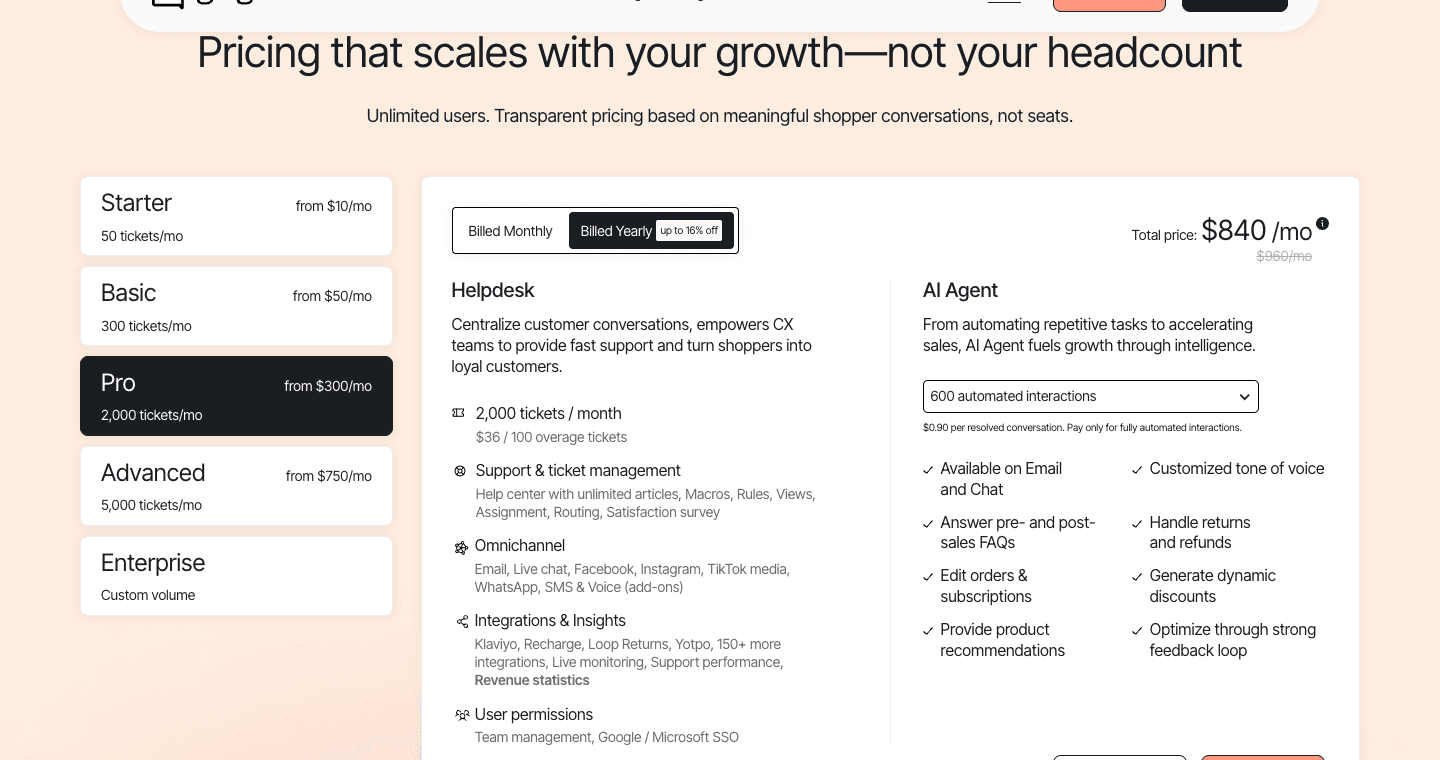
The same ecommerce focus also creates the usual switching triggers. Teams compare alternatives when ticket volume spikes seasonally, when they prefer per-agent pricing, when they need enterprise governance, when marketplace support matters more than Shopify order actions, or when AI resolution pricing needs a different cost model. None of those are “Gorgias is bad” reasons. They are “our support operation changed shape” reasons.
The cleanest way to choose is to separate three questions: do agents need deep ecommerce order context, do managers need mature enterprise support operations, and does the finance team prefer seat, ticket, or outcome-based pricing? The rest of the comparison gets much easier after that.
When Gorgias Is Still the Right Choice
Keep Gorgias on the shortlist if your team lives in Shopify support, wants a helpdesk that understands ecommerce tickets by default, and values order context more than generic IT-style ticketing depth. For a Shopify-first brand, the ability to answer support questions, see customer/order context, trigger macros, route messages, and connect ecommerce apps in one place can beat a cheaper seat-based tool that needs extra setup.
Gorgias also makes sense when you have many occasional collaborators. Its public pricing is not per user for helpdesk tiers, so a team with part-time CX contributors may prefer ticket-volume economics over paying for every seat. That tradeoff only works if you model seasonal volume and overages before signing.
How We Evaluated the Alternatives
We compared each tool by ecommerce support fit, pricing model, live chat and social coverage, automation and AI economics, reporting, governance, migration risk, and how much setup it takes to replace Gorgias without dropping order-context workflows. The source baseline came from official pricing and product pages checked on June 2, 2026, plus public SERP benchmarking. See the ToolBlueprints methodology for how we evaluate software pages.
If you want a broader directory beyond this shortlist, start with the customer support tools category.
Zendesk
Best for: larger ecommerce teams that need omnichannel routing, reporting, AI, voice, help center, app marketplace depth, and enterprise governance.
Not for: lean Shopify brands that want ecommerce order actions to work out of the box with minimal admin work.
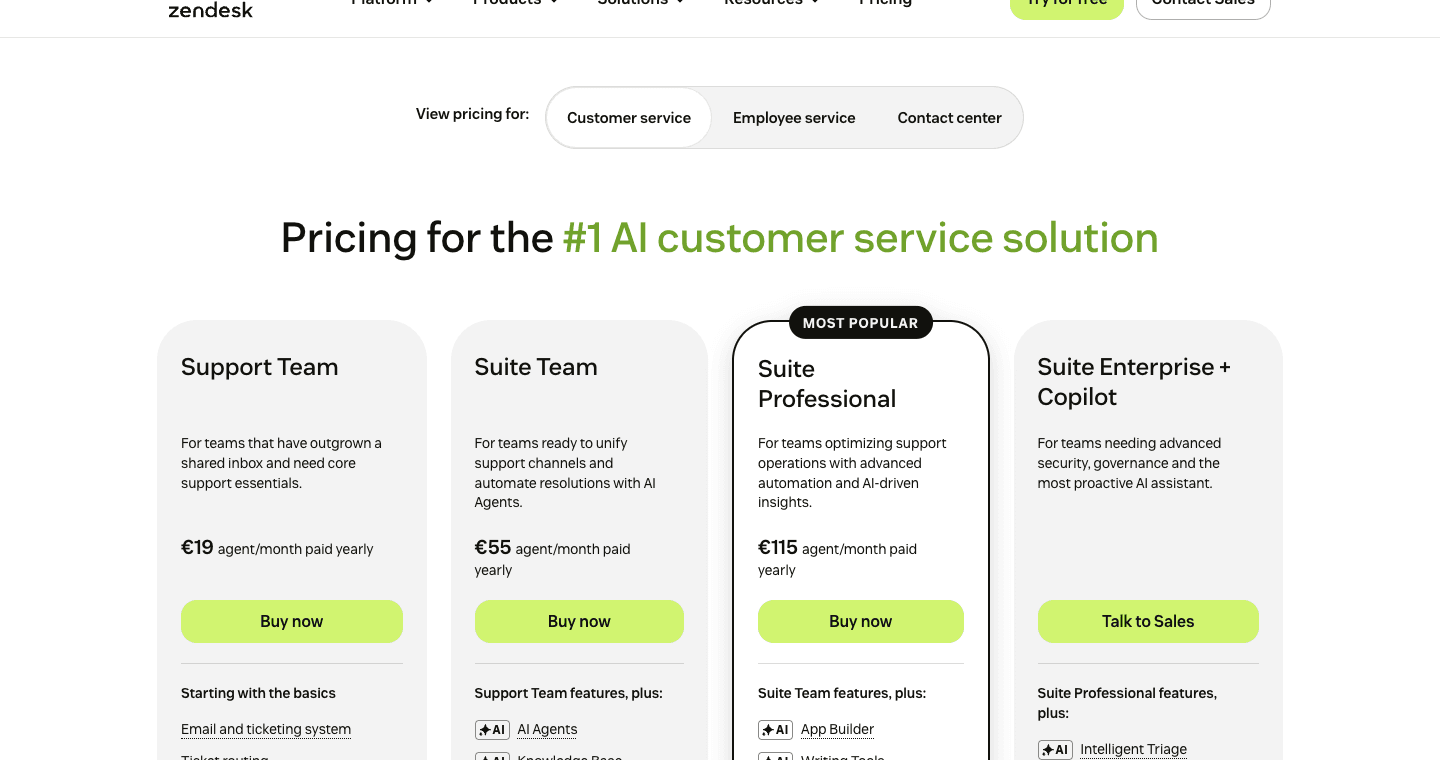
Zendesk is the safest Gorgias replacement when support has grown beyond the ecommerce helpdesk stage. Its pricing page lists Support Team from $19 per agent/month paid yearly, Suite Team from $55, Suite Professional from $115, and an Enterprise + Copilot tier that requires sales. Zendesk also notes add-ons and usage-based elements, including AI agent resolutions.
The reason to switch is operational maturity. Zendesk has deeper routing, help center, AI, app marketplace, reporting, phone, permissions, security, and admin patterns than most ecommerce-first support tools. If your CX team needs workforce-style process control, Zendesk is easier to defend to operations leadership.
Where Gorgias still wins is ecommerce speed. Shopify order context, returns app context, macros, and ecommerce-specific workflows may feel more native in Gorgias. Zendesk can support ecommerce well, but expect setup work and marketplace apps rather than a pure one-for-one move.
Pricing source: Zendesk pricing.
Help Scout
Best for: small and mid-size teams that want a friendly shared inbox, live chat, docs, workflows, and enough AI without turning support into a control panel full of switches.
Not for: brands that need deep in-ticket ecommerce order actions, complex SLA operations, or heavy marketplace workflows.
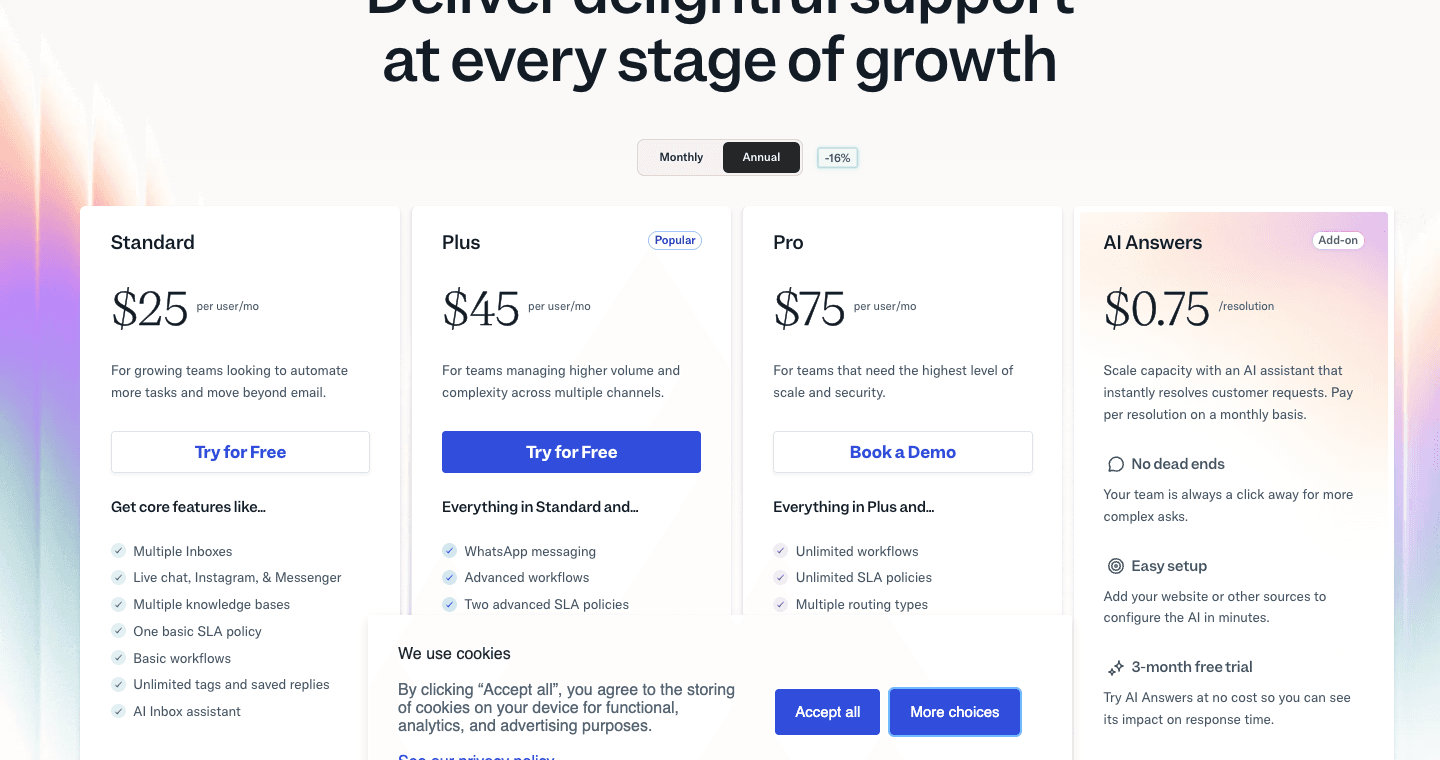
Help Scout is the “make support feel sane again” alternative. Its pricing page lists Standard at $25 per user/month, Plus at $45, Pro at $75, AI Answers at $0.75 per resolution, and a Free plan with 5 users, 1 inbox, and 1 Docs site. That makes it easier to test than enterprise-first platforms.
Switch from Gorgias to Help Scout if the team is spending more effort maintaining the support platform than answering customers. The product is strong for email support, live chat, docs, workflows, saved replies, tags, and a calmer agent experience.
Gorgias still wins when ecommerce context is the center of the work. If agents constantly need order edits, returns context, subscription data, and Shopify-native action speed, Help Scout may need supporting apps and process workarounds.
Pricing source: Help Scout pricing.
Freshdesk
Best for: teams that want a broader helpdesk at predictable agent-based pricing, especially when ticketing, portals, reports, and basic AI matter more than ecommerce specialization.
Not for: Shopify-first teams that expect ecommerce order context and CX app integrations to be the default operating model.
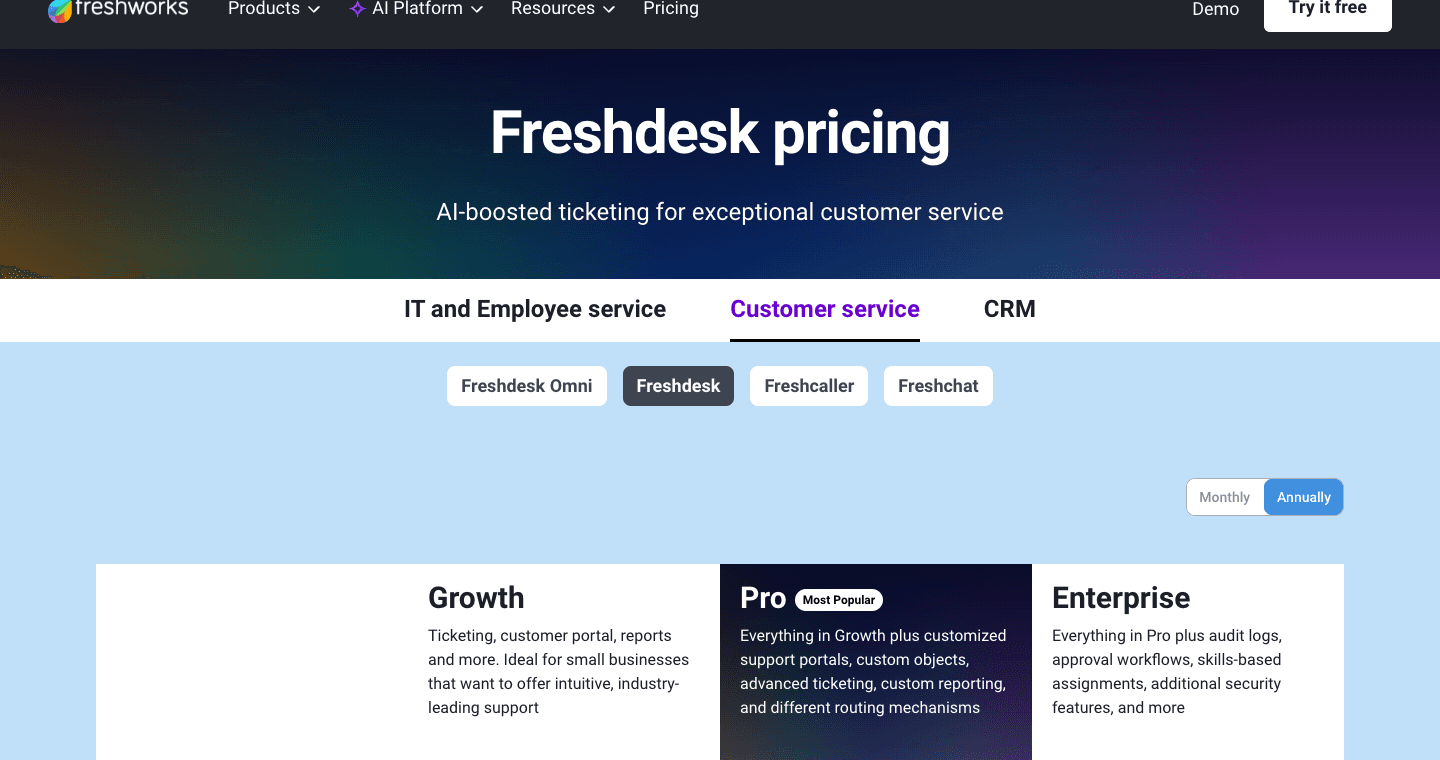
Freshdesk is the budget-aware generalist in this list. Freshworks lists Freshdesk Growth at $19 per agent/month billed annually, Pro at $55, Enterprise at $89, plus a temporary $0 program for 1-2 agents for 6 months. The page also notes Freddy AI Agent sessions and add-on caveats.
Switch from Gorgias to Freshdesk if your support operation needs standard helpdesk features at a clearer per-agent price: ticketing, shared inbox, customer portal, reports, multilingual helpdesk, routing, and Freshworks ecosystem coverage.
The tradeoff is ecommerce setup. Freshdesk can be made to work for online stores, but it is not as opinionated around Shopify support as Gorgias. Budget the migration around integrations, order lookup, macros, and reporting definitions.
Pricing source: Freshdesk pricing.
Re:amaze
Best for: ecommerce teams that want a lighter helpdesk with live chat, bots, FAQ, social channels, multi-brand support, and predictable per-teammate plans.
Not for: large CX organizations that need enterprise-grade governance, deep analytics, workforce management, or very custom data architecture.
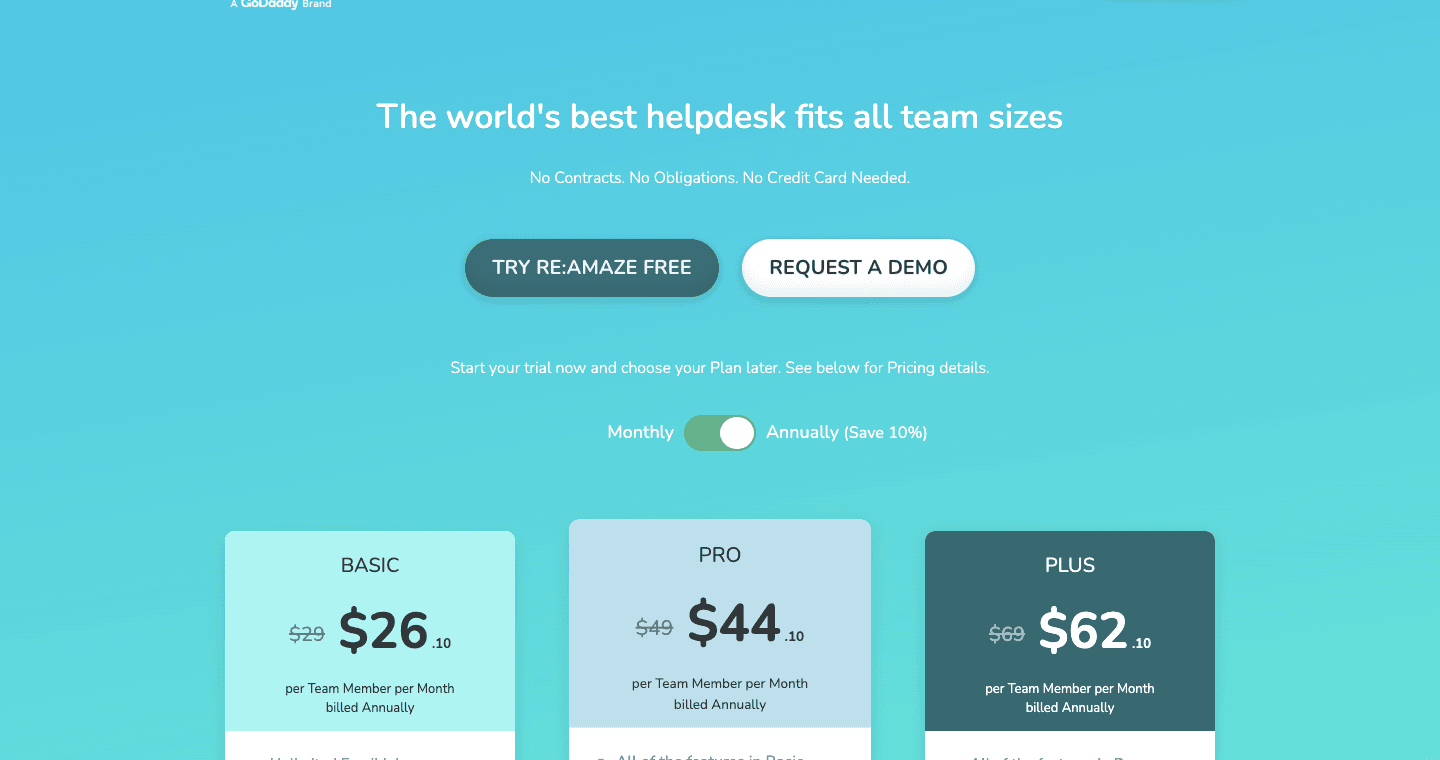
Re:amaze is the most natural “still ecommerce, but lighter” alternative on the required shortlist. Its pricing page lists Basic at $29 per team member/month, Pro at $49, Plus at $69, annual discounts, a $59/month flat-rate Starter plan for teams limited to 500 responded conversations, free trials, and AI Agent resolution allowances with additional resolution pricing.
Switch from Gorgias to Re:amaze if your team wants ecommerce-friendly chat, inbox, social, FAQ, bots, proactive messages, and multi-brand support without committing to a heavier enterprise suite. It is especially attractive when Gorgias ticket-volume economics feel less predictable than per-seat planning.
Gorgias still wins when Shopify-native depth is the buying reason. If agents rely on deep ecommerce actions and a large Shopify app ecosystem, test Re:amaze with real tickets before moving the whole queue.
Pricing source: Re:amaze pricing.
Kustomer
Best for: enterprise ecommerce and retail teams that want a customer timeline, custom data model, AI orchestration, multi-brand support, and governance depth.
Not for: small stores that mainly need a Shopify inbox and fast support macros.
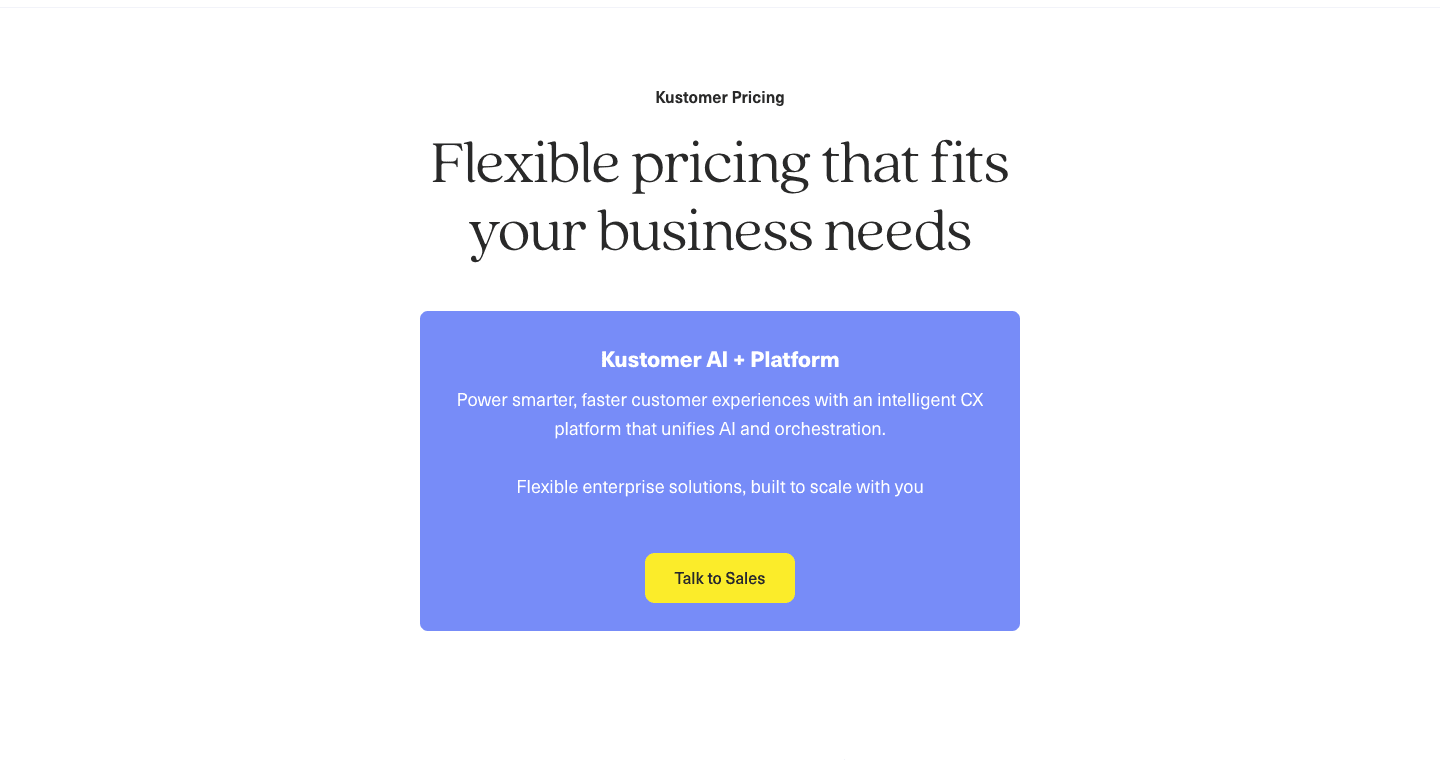
Kustomer is not the cheapest Gorgias alternative, and that is the point. Its pricing page is sales-led and frames Kustomer AI + Platform as a flexible enterprise solution. The public page highlights AI profiles, external sources for AI, custom objects, high API limits, brand support, languages, and orchestration-oriented capabilities.
Switch from Gorgias to Kustomer if your support team is becoming a customer operations function. The fit is strongest when customer data, multiple brands, custom attributes, compliance, and a timeline-style view matter more than simply moving Shopify tickets faster.
Gorgias still wins for speed and ecommerce specificity. Kustomer is a platform decision; Gorgias is often a support-team decision. If that distinction feels academic, Kustomer is probably too much.
Pricing source: Kustomer pricing.
Intercom
Best for: teams that want customer messaging, inbox, help center, automation, and Fin AI to carry more of the support experience.
Not for: teams whose support value depends on ecommerce order operations rather than customer messaging and AI resolution.
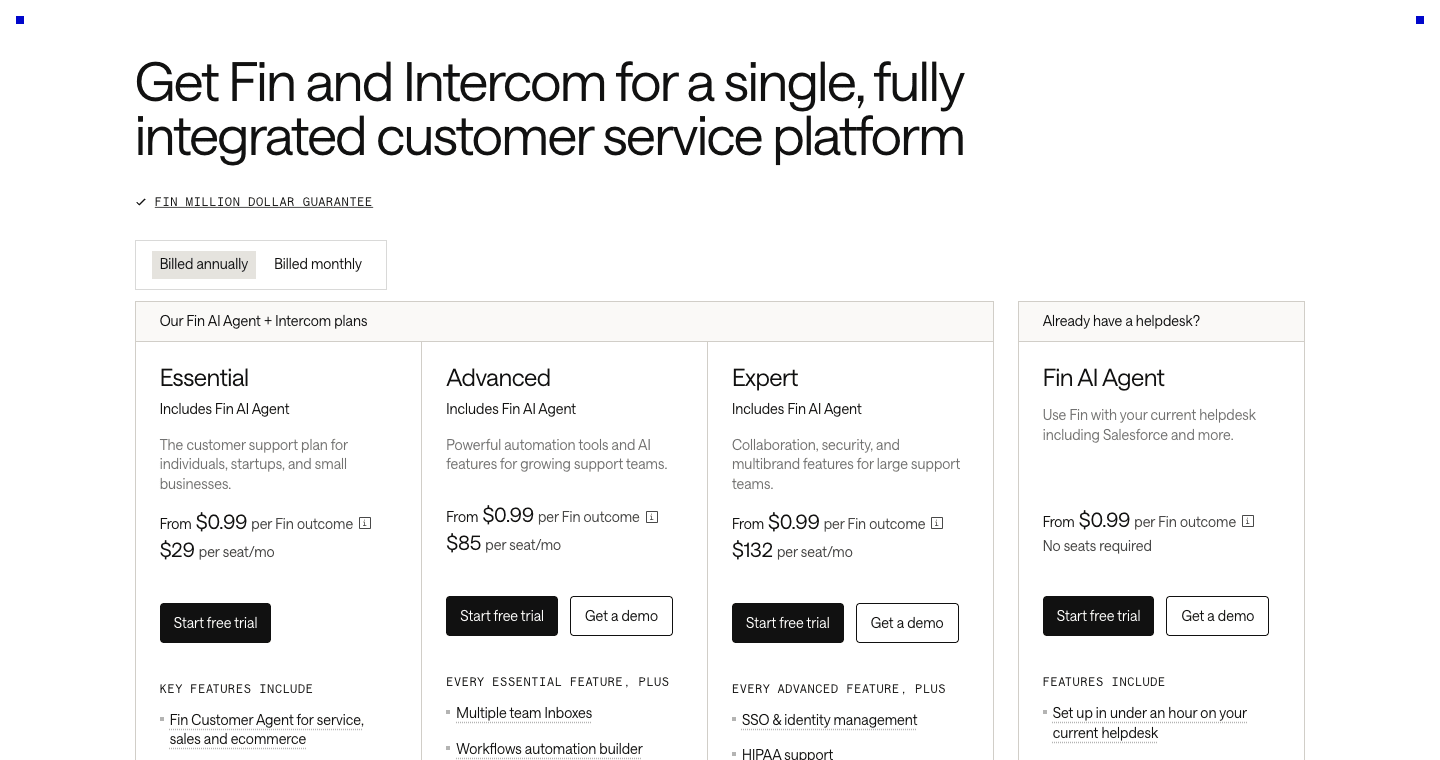
Intercom is the strongest chat-and-AI-first alternative. Its pricing page lists Essential at $29 per seat/month, Advanced at $85, Expert at $132, and Fin AI Agent from $0.99 per outcome. It also explains that Intercom pricing combines seats with usage, and that the free trial runs for 14 days.
Switch from Gorgias to Intercom if the team wants Messenger, shared inbox, ticketing, prebuilt reports, workflows, help center, and Fin-led AI resolution. Intercom is especially attractive when support overlaps with product education, onboarding, or proactive customer messaging.
Gorgias still wins for ecommerce support actions. Intercom can support ecommerce brands, but its center of gravity is customer communication and AI, not Shopify order management. Model Fin outcomes and any messaging add-ons before calling it cheaper.
Pricing source: Intercom pricing.
Tidio
Best for: small ecommerce teams that need live chat, ticketing, flows, and Lyro AI without buying a full enterprise helpdesk.
Not for: complex support operations with strict SLA routing, many brands, deep reporting, and heavy back-office order workflows.
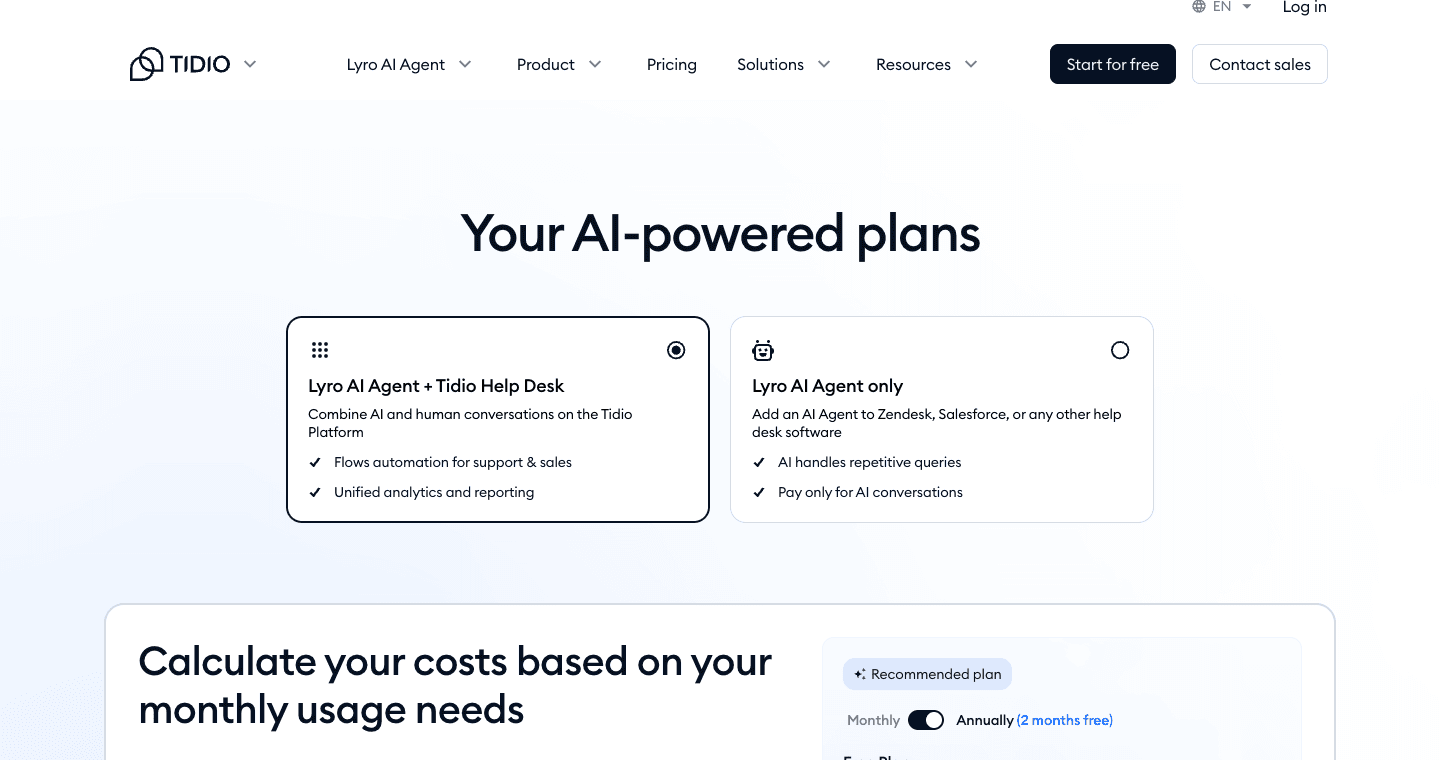
Tidio is a practical Gorgias alternative when the support problem is chat responsiveness and simple automation rather than a full ecommerce CX operating system. Its pricing page lists Starter at $24.17/month annually for 100 billable conversations, Growth from $49.17/month annually, Plus from $749/month, Premium by quote, and a 7-day trial.
Switch from Gorgias to Tidio if your store needs a fast chat layer, Lyro AI, flows, visitor context, and approachable pricing. It can be a strong first support stack for small stores that are not ready for Gorgias ticket-volume pricing or Zendesk-level implementation.
Gorgias still wins for helpdesk replacement depth. Tidio is not the obvious choice when agents need rich order actions, complex macros, returns context, and mature support operations.
Pricing source: Tidio pricing.
Richpanel
Best for: ecommerce brands that want AI self-service and repetitive-ticket deflection to be the economic center of the support stack.
Not for: teams looking only for a cheaper shared inbox or a simple per-agent helpdesk.
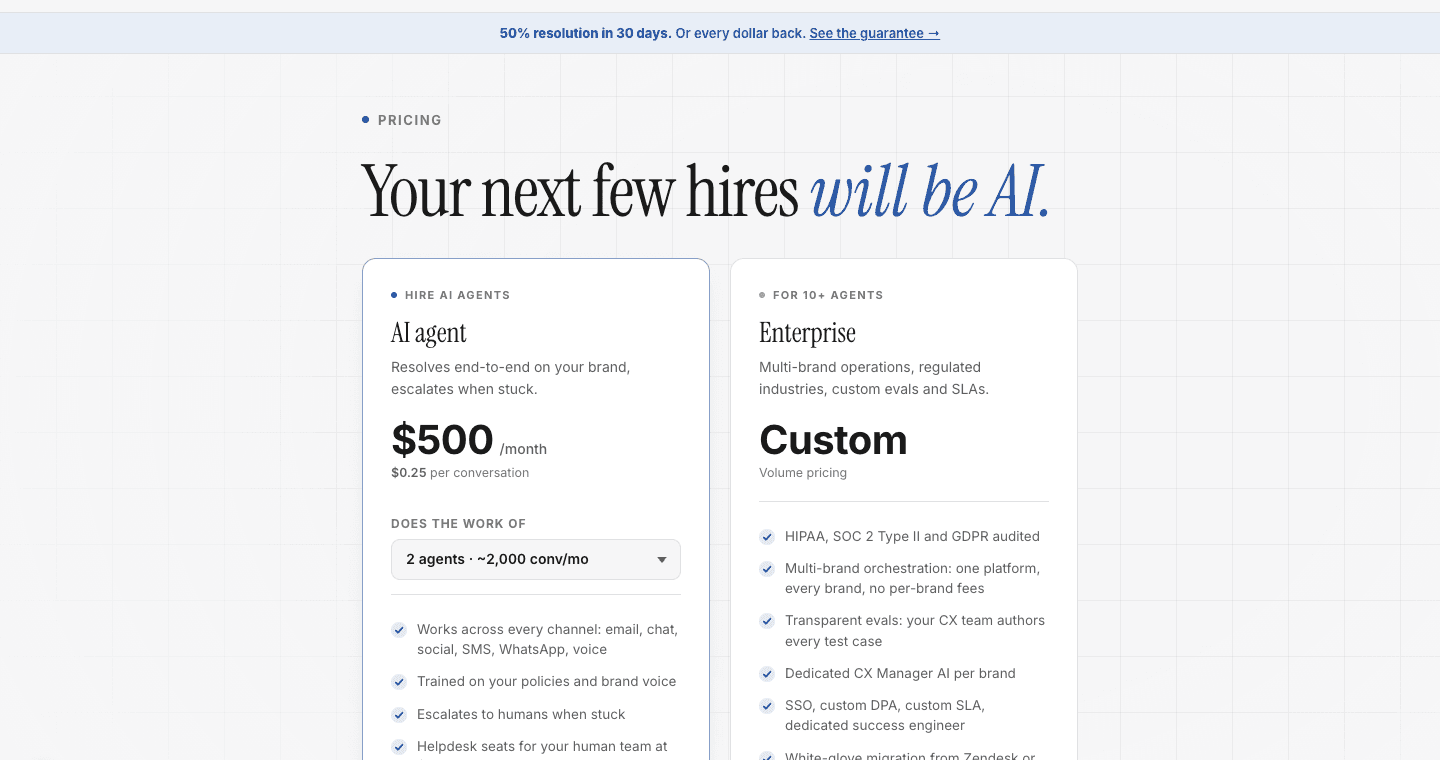
Richpanel is the most direct ecommerce AI deflection bet in this list. Its pricing page lists an AI agent at $500/month plus $0.25 per conversation, human helpdesk seats at $100/seat/month, and enterprise volume pricing. The page also claims white-glove migration from Zendesk or Gorgias at any scale.
Switch from Gorgias to Richpanel if the business case is not “another inbox” but “fewer repetitive contacts.” That matters for ecommerce teams flooded with where-is-my-order, returns, exchanges, policy, and shipping questions.
Gorgias still wins if your team wants a more established ecommerce helpdesk with broad app recognition and lower entry plans. Richpanel requires confidence in the AI/self-service operating model and enough volume to justify the base cost.
Pricing source: Richpanel pricing.
Which Alternative Should You Choose?
Choose Zendesk if support has become a real operations function with routing, reporting, governance, phone, and enterprise stakeholders. Choose Re:amaze if you still want ecommerce-friendly support but want a lighter and more predictable helpdesk. Choose Help Scout if adoption and agent happiness matter more than ecommerce automation depth. Choose Freshdesk if price predictability and general helpdesk coverage are the main reasons to leave.
Choose Intercom if the support experience should be messaging- and AI-led. Choose Tidio if you are a smaller store trying to add chat and automation without buying a large CX platform. Choose Kustomer if customer data architecture matters. Choose Richpanel if self-service and AI deflection are the core thesis.
Stay with Gorgias if Shopify context is what makes the support team fast. Switching away from Gorgias only pays off when the replacement solves a specific constraint: pricing model, enterprise depth, simplicity, chat/AI, or customer-data control.
Migration Checklist
- Export at least 90 days of Gorgias tickets, tags, macros, rules, views, CSAT, channel data, and automation reports before making changes.
- Map every ecommerce action agents use today: order lookup, refunds, returns, exchanges, subscription edits, discount exceptions, and shipping updates.
- Rebuild macros and automations by intent, not by copying old rules one by one. Old support rules often include yesterday’s emergency patches.
- Run the new platform in parallel for one support cycle and compare first-response time, resolution time, escalation rate, CSAT, AI deflection, and cost per resolved conversation.
- Verify Shopify, returns, reviews, subscription, loyalty, shipping, email/SMS, and marketplace integrations with real test orders.
- Train agents on the new ticket taxonomy before launch so reports do not become a mixed bag of “misc,” “other,” and quiet despair.
- Keep Gorgias read-only access during the transition until historical tickets, customers, and reports are searchable in the new workflow.
FAQs
What is the best Gorgias alternative for ecommerce support? For most larger ecommerce teams, Zendesk is the strongest broad replacement. For a lighter ecommerce-specific move, Re:amaze is the more direct helpdesk alternative. For AI self-service, compare Richpanel and Intercom closely.
Is there a cheaper alternative to Gorgias? Freshdesk, Help Scout, Tidio, and Re:amaze can be cheaper depending on agent count, ticket volume, AI usage, and channel needs. The cheapest option on paper is not always cheaper after adding ecommerce integrations and automation.
Should Shopify stores leave Gorgias? Not automatically. Shopify-first teams often get real value from Gorgias order context and ecommerce integrations. Leave only when a specific constraint matters more than that native workflow.
Which Gorgias alternative is best for AI support? Intercom is strong for Fin-led customer messaging, Tidio is approachable for smaller chat teams, Richpanel focuses on ecommerce AI/self-service deflection, and Zendesk brings AI into a broader enterprise service platform.
How hard is it to migrate from Gorgias? The hard part is not moving tickets. It is rebuilding ecommerce context, macros, routing, order actions, AI intent handling, reporting, and agent habits. Plan a parallel run before shutting off the old queue.
Final Recommendation
For ecommerce support teams outgrowing Gorgias, Zendesk is the best all-around replacement when operational depth matters. Re:amaze is the best lighter ecommerce helpdesk alternative. Help Scout and Freshdesk are better for simplicity and predictable seat-based budgets. Intercom, Tidio, and Richpanel make sense when AI and chat are the actual switching reason, while Kustomer belongs in enterprise evaluations where customer data architecture is part of the problem.
The practical answer: do not switch because another tool has a longer feature grid. Switch because its pricing model, implementation shape, and support workflow match the way your ecommerce team actually resolves customer problems.